

How Did The Makeup Of The Senate Change After The Passage Of The 17th Amendment?
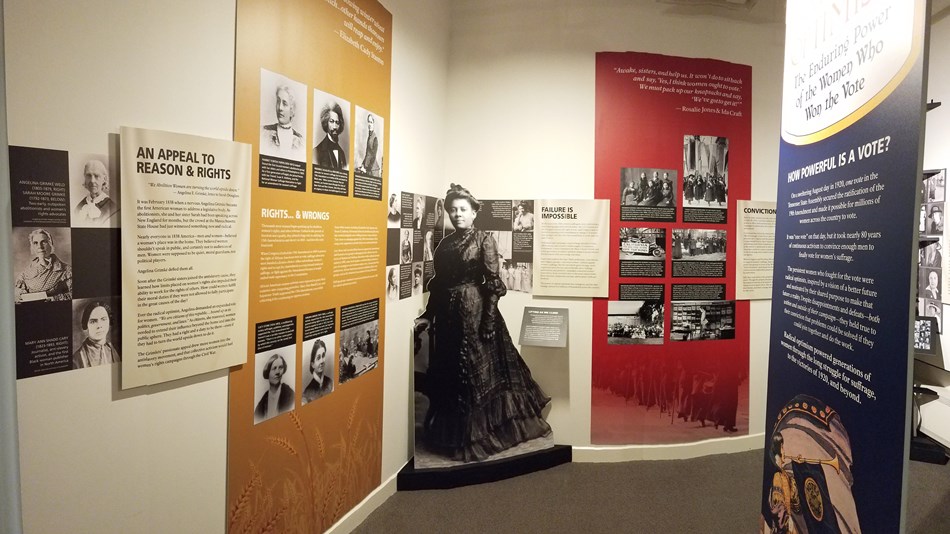
Radical Optimism
Radical Optimism features an overview of generations of women who dedicated themselves to the struggle for women's voting rights.
Explore this Page Navigation

Library of Congress
An Overview of the 19th Subpoena
In 1848 women and men met in Seneca Falls, New York to advance the cause for women's rights. The convention, organized past Elizabeth Cady Stanton, Lucretia Mott, Martha Wright, Mary Ann G'Clintock, and Jane Chase marked the beginning of a formal women'southward suffrage movement. The men and women of the movement made speeches and petitioned Congress, pressuring authorities officials to recognize the woman'south right to vote. Stanton, Mott, and suffrage advocate Susan B. Anthony did not live to run across women get the right to vote. Instead, they paved the way for future suffragists similar Alice Paul, Ida B. Wells, and Mabel Ping-Hua Lee.
The women leading the women's suffrage motility were not always unified. Some suffragists thought only white women should exercise their right to vote. Others like Charlotte Forten Grimke, Mary Ann Shadd Cary, and Mary Church Terrell knew women of colour also had a correct to participate in electing government officials.
The showtime constitutional amendment to secure votes for women was introduced to congress in 1878. It failed. By 1919, suffragists become another subpoena introduced to congress that would secure women'south correct to vote. The xixthursday Amendment passed both the Business firm and Senate. The states ratified the 19thursday Amendment in 1920, officially recognizing women's right to vote.

Library of Congress
While many women were able to head to the polls, the amendment did not give voting rights to all women. Women of color, immigrants, and lower income women were often deterred from voting by laws and social pressure. For example, Native American women were not considered U.s.a. citizens until 1924 and were not permitted to vote. Women who were convicted of a crime were as well unable to vote, even if they completed their sentence.
After the ratification of the 19th Amendment in 1920, suffragists similar Alice Paul knew that their piece of work was not finished. While the government recognized women's right to vote, many women still faced discrimination. Paul and other members of the National Adult female'southward Party drafted the Equal Rights Amendment. If ratified, the subpoena would guarantee equal rights to all people regardless of their gender. The Equal Rights Amendment was ratified by both houses of Congress in the 1970s but failed to go acceptable support from the states. Information technology has non however been ratified to the Constitution.
Women's rights advocates did make progress in passing other legislation afterward 1920. Congress passed the Equal Pay Act in 1963, making information technology illegal to pay a woman less for doing the same job every bit a homo. A year after, Congress passed the Civil Rights Human action of 1964. This act is often associated with the Civil Rights Movement as it prohibits employers from discriminating confronting an individual based on their race. The act as well states that employers cannot discriminate against someone based on their gender. Before the Civil Rights Act of 1964, employers could choose not to rent a woman because of her gender.

Library of Congress
A century subsequently the ratification of the nineteenthursday Amendment, women are even so advocating for their rights. This activism would be impossible without the power of the vote that enables women to have a say in the republic they live in. The 19thursday Amendment is a milestone in American history.
A Brief Timeline of the 19th Amendment
- June 1848- The outset Woman's Rights Convention takes place in Seneca Falls. Suffrage is function of the resulting Declaration of Sentiments
- February iii, 1870- The 15th Amendment is ratified, guaranteeing the right to vote regardless of race, color, or previous status of servitude.
- January 1878- A women's suffrage amendment is introduced to Senate. It fails in 1887.
- 1914- Another women's suffrage subpoena is introduced. It likewise fails.
- 1918- The xixth Amendment passes the Firm then fails in the Senate by 2 votes.
- February 10, 1919- The nineteenthursday Amendment fails in the Senate by 1 vote.
- May 21, 1919- The xixth Amendment passes in the House.
- June iv, 1919- The 19th Subpoena passes in the Senate.
- June x, 1919- Wisconsin and Michigan are the commencement states to ratify the 19th Amendment.
- August 18, 1920- Tennessee is the 36thursday State to ratify the nineteenth Subpoena police, passing the three-fourths threshold requirement for the subpoena to become law.
- August 26, 1920- The xixthursday Amendment is adopted every bit part of the U.s. Constitution.
Voting Rights After the nineteenthursday Subpoena

LBJ Presidential Library
The 19th Amendment did non guarantee that all women and men in the Usa could vote. Securing this essential correct has been an long struggle, that for some, continues on to this day.
-
1924, Indian Citizenship Deed- Native Americans deemed Usa citizens, but states go on to make up one's mind who votes. Many continue to disenfranchise Native Americans.
-
1943, Magnuson Act- Chinese in America granted the right to get citizens, and therefore to vote (the Chinese Exclusion Act of 1882 previously prevented this)
-
1962- Utah is the final state to enfranchise Native Americans.
-
1965, Voting Rights Act- African Americans and Native Americans continued to face exclusion from voting through mechanisms like poll taxes, literacy tests, and intimidation. The Voting Rights Deed of 1965 eliminated many of these.
Learn more virtually the 19th Amendment

How Did The Makeup Of The Senate Change After The Passage Of The 17th Amendment?,
Source: https://www.nps.gov/wori/learn/historyculture/2020-crash-course.htm
Posted by: dunlapsuposincer.blogspot.com
0 Response to "How Did The Makeup Of The Senate Change After The Passage Of The 17th Amendment?"
Post a Comment